
Article summary
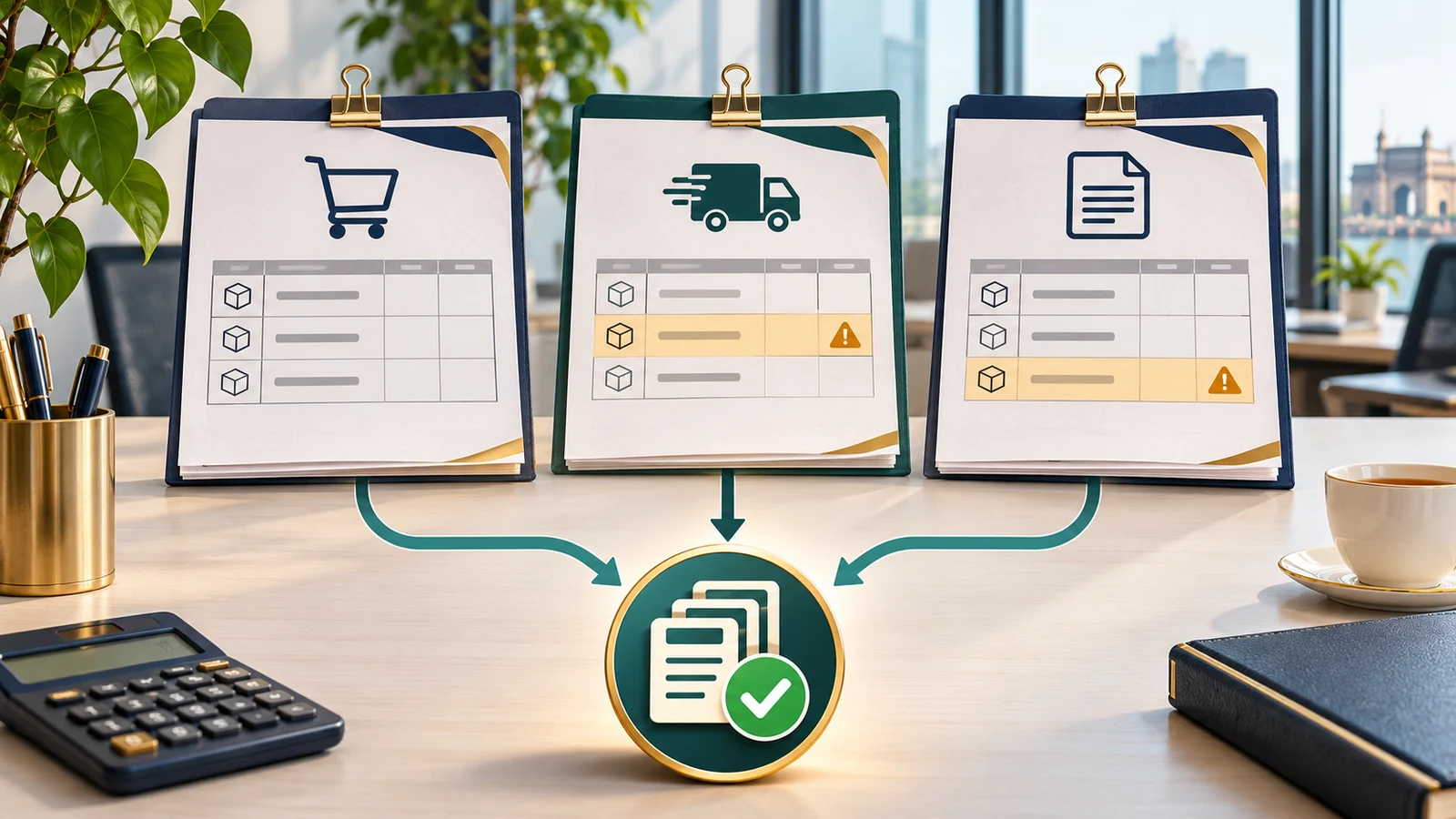
Three-way matching compares a purchase order, receipt and supplier invoice before payment approval. In this fictional worked case, one item was only partly received and another costs more than the agreed unit price. Compare the records, calculate each difference and decide what evidence is needed next. Figures are INR before tax; actual approval and tax rules depend on the organisation.
What each document is meant to prove
- The approved purchase order records the supplier, agreed item, quantity and unit price. It does not prove delivery.
- The goods receipt records accepted quantities. For services, the authorised owner may need to document acceptance of the work rather than a warehouse receipt.
- The supplier invoice is a request for payment. Its quantities, unit prices, references and supplier details need checking against the other records and the approved supplier record.
The check is performed at the appropriate line level. A total that appears plausible can conceal different problems on different items. An organisation may configure tolerances and approval routes, but a tolerance is a defined policy setting, not permission for an analyst to silently change a source record.
Work the fictional PO, receipt and invoice
Practice PO-204 orders three supplies from a fictional vendor. GR-204 records the accepted delivery and INV-204 is the supplier invoice. All amounts are INR before tax. The invoice claims INR 38,500 against a PO value of INR 37,000. Compare each line before looking at the answer.
| Item | PO quantity × price | Received | Invoice quantity × price | Invoice amount |
|---|---|---|---|---|
| A: storage boxes | 100 × 200 | 80 | 100 × 200 | 20,000 |
| B: printer packs | 50 × 300 | 50 | 50 × 330 | 16,500 |
| C: labels | 20 × 100 | 20 | 20 × 100 | 2,000 |
Answer key: identify the two different breaks
| Item | Comparison | Result | Next evidence or action |
|---|---|---|---|
| A: storage boxes | 100 invoiced − 80 received = 20 unreceived; 20 × INR 200 = INR 4,000 | Quantity exception | Check whether a later receipt exists. If not, ask for a corrected invoice or the approved route for an outstanding quantity. |
| B: printer packs | INR 330 − INR 300 = INR 30 per pack; 50 × INR 30 = INR 1,500 | Price exception | Check approved PO changes or obtain a corrected invoice; do not rewrite the PO without authority. |
| C: labels | 20 ordered, received and invoiced at INR 100 | Matches these three records | Continue the remaining supplier, duplicate, tax and approval checks. |
If the supplier issued a corrected invoice for only 80 units of A at INR 200, 50 units of B at INR 300 and 20 units of C at INR 100, the corrected pre-tax total would be INR 16,000 + INR 15,000 + INR 2,000 = INR 33,000. The 20 unreceived boxes remain an open delivery question. This calculation is an exercise, not an instruction to approve part of INV-204: an actual correction, credit, receipt and payment need their own documented authorisation.
Why a two-way check would miss part of this case
A two-way comparison of PO and invoice would reveal Item B's unit-price difference. It would not reveal that only 80 of Item A's 100 invoiced boxes were accepted, because its invoice quantity and price match the PO. The receipt is the third piece of evidence that exposes the quantity break. Microsoft describes this distinction in its accounts-payable matching documentation; specific matching tolerances and system settings vary by implementation.
Write an exception record another reviewer can use
A useful record identifies PO-204, GR-204 and INV-204; the exact affected line; the observed difference; where each figure came from; the person or team assigned to investigate; and the status of the requested evidence. It should avoid saying that the supplier is wrong or that payment is safe until the discrepancy is resolved under the approved process. In this case the quantity issue belongs with the receiving or purchasing owner, while the price issue may require the buyer and authorised PO approver.
- Preserve the source documents and note the version and date checked.
- Place the mismatched line or invoice into the approved exception workflow; do not force a match by editing quantities.
- Ask the responsible owner for a later receipt, approved PO change, supplier correction or other permitted evidence.
- Record the reviewer decision and only then resume the remaining invoice and payment controls.
What three-way matching does not establish
Even Item C's document match does not prove that the vendor bank account is genuine, the invoice is unique, the goods meet quality requirements, the tax treatment is correct or payment has the right approval. A duplicate invoice can match the same PO and receipt unless separate duplicate controls catch it. A service invoice may need signed service-acceptance evidence. These checks belong in the wider procure-to-pay process, alongside segregation of duties, exception ageing and reconciliation.
Source and scope
The three-document logic and the distinction between quantity and price discrepancies were checked against Microsoft Learn's accounts-payable invoice-matching overview. That documentation describes one software implementation; the fictional PO, receipt, invoice, calculations and exception log above were created for this learning exercise. No employer's tolerance, tax rule or approval authority is implied.