
Article summary
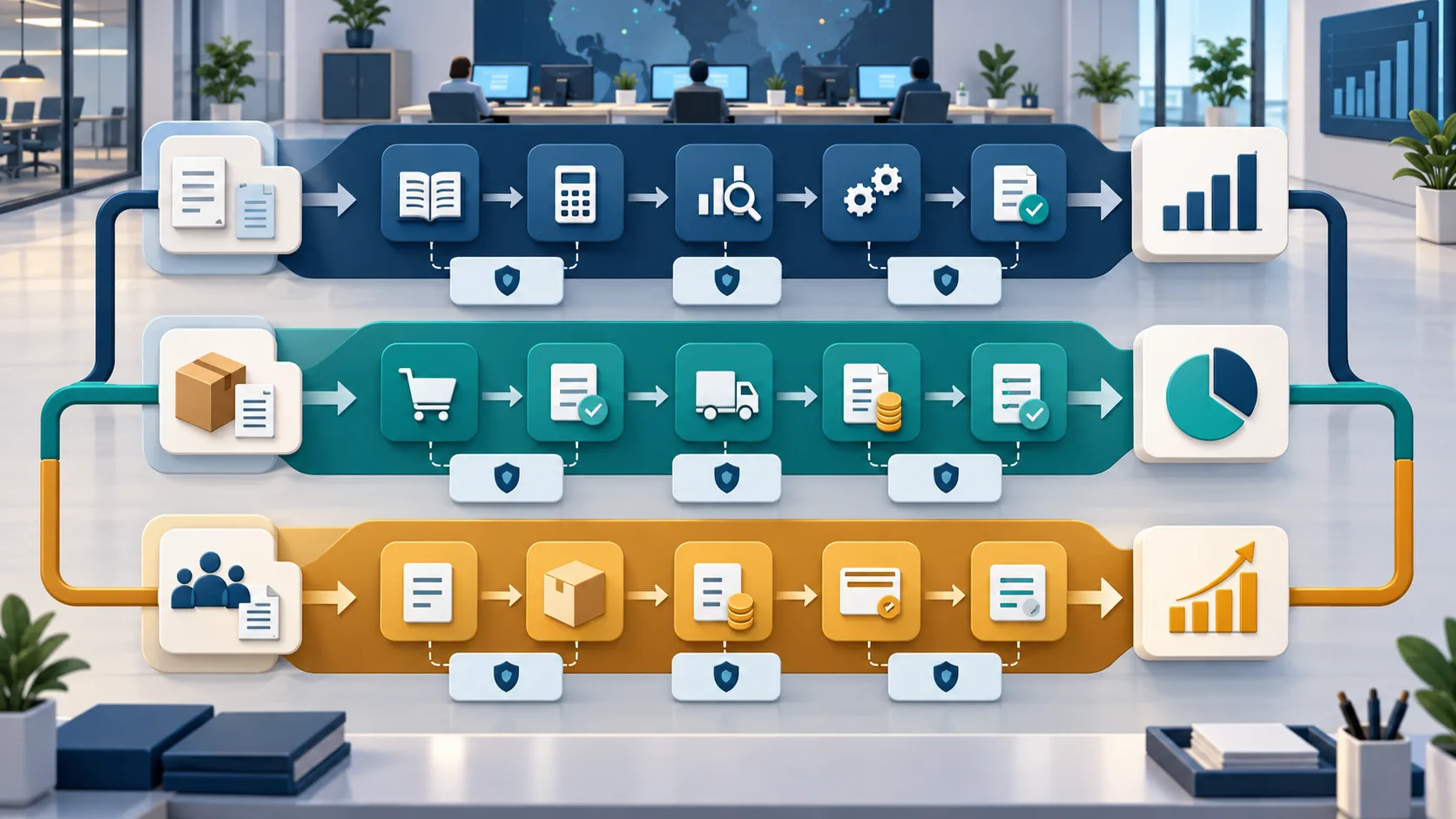
The order to cash process follows a customer order through fulfilment, billing, receivables, collection and payment allocation. Finance teams use the connected records to establish what was ordered, delivered, invoiced and paid, and what remains unresolved. This guide traces one invented order and a short payment so you can practise the handoffs rather than memorise a list of stages.
Order to cash process steps and control points
| Step | Output | Control question |
|---|---|---|
| 1. Validate customer and order | Approved customer and sales order | Are customer, terms, items and prices authorised? |
| 2. Review credit and release | Recorded release decision | Has the responsible owner approved the exposure? |
| 3. Fulfil and record delivery | Delivery or service evidence | What quantity or work was accepted? |
| 4. Bill the customer | Invoice linked to source records | Does the billed amount agree with the approved basis? |
| 5. Monitor receivables | Open-item and ageing record | Which amounts are due, disputed or awaiting action? |
| 6. Identify and apply receipts | Supported allocation record | Which customer and invoice does the cash belong to? |
| 7. Reconcile and resolve exceptions | Explained closing balance | Do invoices, credits, receipts and the ledger agree? |
These stages describe a learning model, not a universal accounting policy. Cash-at-sale businesses, subscriptions, services and credit sales can follow different routes. Revenue recognition, tax, credit approval and posting authority must follow the applicable framework and organisation policy; issuing an invoice or receiving cash alone does not settle every accounting question.
Fictional case: an order for 100 units
Mira Supplies is invented. Sales order SO-310 records 100 units at INR 500 each before tax. The approved customer terms and release are assumed to be on file. Delivery record DL-310 confirms acceptance of all 100 units. Invoice INV-310 therefore requests INR 50,000 before tax. Tax, currency differences, settlement discounts and bank fees are deliberately excluded so the exercise isolates quantity, price and allocation.
| Record | Quantity or amount | What it supports |
|---|---|---|
| SO-310 | 100 units x INR 500 = INR 50,000 | Approved commercial basis |
| DL-310 | 100 accepted units | Recorded fulfilment |
| INV-310 | INR 50,000 | Customer amount billed |
| RC-310 | INR 47,500 | Observed receipt requiring allocation |
Investigate the INR 2,500 short payment
The customer remittance references INV-310 but deducts INR 2,500 for five units it says were damaged. The analyst observes a difference of INR 50,000 - INR 47,500 = INR 2,500. This is a claim requiring investigation, not automatic evidence that the invoice is wrong. Preserve the remittance, compare it with the delivery and quality records, and send the dispute to the authorised owner.
If the receipt is identified and the approved process allows allocation, INR 47,500 can be recorded against the invoice while the INR 2,500 remains open and disputed. Do not silently change the invoice value, treat the deduction as a discount or write off the difference to make the account close. The actual posting and allocation are performed only under authorised policy.
Two possible outcomes and their reconciliation
| Outcome | Balance calculation | Result |
|---|---|---|
| Claim accepted; approved credit note CN-310 issued for INR 2,500 | 50,000 invoice - 47,500 applied receipt - 2,500 credit | Zero open receivable for this invoice |
| Claim rejected; customer later pays INR 2,500 | 50,000 invoice - 47,500 first receipt - 2,500 later receipt | Zero after the second supported allocation |
| No decision or additional payment yet | 50,000 invoice - 47,500 applied receipt | INR 2,500 remains open and disputed |
The first outcome resolves the balance with an authorised credit; the second resolves it with additional cash. They have different evidence and accounting effects. An analyst reviewing the close should be able to see which event actually occurred and when. A promise to send a credit note is not the issued, approved record. A promised payment is not cash received.
What an O2C exception log should contain
- Customer, sales order, delivery, invoice and receipt references.
- Original billed amount, allocated cash and the remaining difference in the same currency.
- Reason stated by the customer, clearly distinguished from a verified finding.
- Dispute owner, date raised, evidence requested and next review date.
- Approved resolution reference and date, with any remaining balance still visible.
For the practice log, write: INV-310 open difference INR 2,500; customer reports five damaged units; delivery record shows 100 accepted; quality owner to review claim and supporting evidence. The note states the discrepancy without accusing either party or implying the claim is already approved. A second reviewer should be able to reconstruct the next action from the record.
Measures that help without hiding exceptions
An O2C team may monitor overdue amounts, unapplied cash, dispute age, invoice accuracy and collection performance. Define each numerator, denominator, cut-off and exclusion before comparing periods. For this case, calling the invoice fully collected because cash arrived would hide the disputed balance. Measuring only closure speed could also encourage an unsupported write-off; pair time measures with evidence quality and unresolved-value checks.
How O2C differs from P2P and R2R
O2C follows customer orders and collections. Procure-to-pay follows purchasing and supplier payments. Record-to-report gathers, reconciles and reports accounting information across those processes. A problem in O2C can therefore become a reporting question during close. The existing process-map article compares the three lanes; this guide owns the detailed order-to-cash steps and short-payment practice case.
Compare R2R, P2P and O2C responsibilities
Read the supplier-side procure-to-pay process
Explore accounts receivable analyst duties and an ageing case
Practice task and sources
Create one worksheet for the four source records, another for the three alternative outcomes and a short exception log. Reproduce the INR 2,500 difference and explain why a credit note and a later receipt are different resolutions. Label all records fictional. Microsoft's process documentation supports the broad O2C sequence and its relationship to other processes; the Mira case, calculations and controls exercise are original educational material.
Microsoft Learn: order to cash process overview
Does order to cash end when the customer sends payment?
A payment still needs identification, supported allocation and reconciliation. Short payments, unidentified receipts or disputes can leave work open.
Is cash application the whole O2C process?
No. Cash application identifies and allocates receipts within a broader customer process that also includes orders, fulfilment, invoicing, credit and collections.