
Article summary
An FP&A interview case may ask you to calculate a budget variance, explain what the figures support, and outline how you would update a forecast. The exercise below uses invented figures for one quarter. It is practice material, not a case from an employer or a description of Centaur Careers' course assessment. FP&A roles vary, so use current job descriptions to decide which planning, reporting and stakeholder skills to prepare.
The fictional interview prompt
A fictional team budgets revenue of ₹100 lakh and operating costs of ₹40 lakh in each of three months. In month one, actual revenue is ₹92 lakh and actual operating costs are ₹39 lakh. The team's working forecast for months two and three is revenue of ₹97 lakh and ₹101 lakh, with costs of ₹40 lakh and ₹41 lakh. All figures refer to the same fictional business, currency and quarter; costs are shown as positive outflows. Calculate month-one contribution, the month-one budget variance, and the quarter's forecast contribution compared with plan. Contribution here means revenue minus the stated operating costs, not a full profit measure.
Step 1: calculate month-one performance
Budgeted contribution for month one is ₹100 lakh minus ₹40 lakh, or ₹60 lakh. Actual contribution is ₹92 lakh minus ₹39 lakh, or ₹53 lakh. The contribution variance is ₹53 lakh minus ₹60 lakh = ₹7 lakh unfavorable. Revenue is ₹8 lakh below budget, while costs are ₹1 lakh below budget. The ₹1 lakh lower cost partly offsets the revenue shortfall; it does not make the contribution variance favorable.
Step 2: compare the quarter forecast with the quarter plan
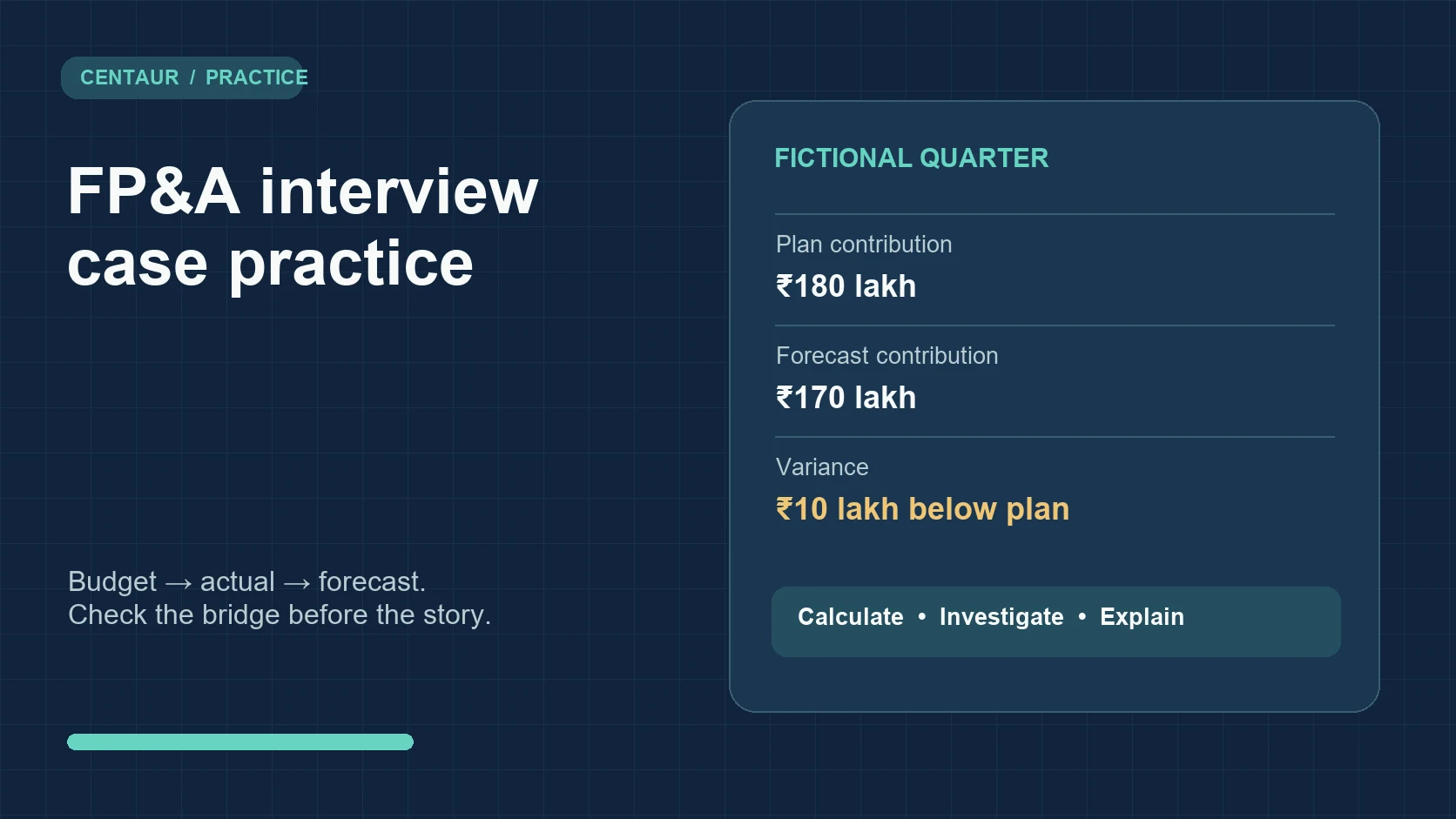
Quarter-plan revenue is ₹300 lakh and plan costs are ₹120 lakh, giving contribution of ₹180 lakh. The current quarter view combines month-one actuals with the two working forecast months: revenue is ₹92 + ₹97 + ₹101 = ₹290 lakh; costs are ₹39 + ₹40 + ₹41 = ₹120 lakh; contribution is ₹170 lakh. Compared with the original quarter plan, contribution is ₹10 lakh unfavorable. This is a forecast based on stated assumptions, not a known quarter-end result.
Step 3: explain what the numbers do not establish
The table does not tell you why revenue was lower. Do not call it a price, volume, customer-loss or timing problem without evidence. Check that revenue and costs use consistent cut-offs and classifications; inspect the source transactions and any known one-off items; ask the responsible team which assumptions support months two and three. Record the owner, date and source of any revised assumption. If the interview gives no further evidence, say which explanation remains a hypothesis.
A model answer you can adapt
Month-one contribution was ₹53 lakh against a ₹60 lakh plan, a ₹7 lakh unfavorable variance. The ₹8 lakh revenue shortfall was partly offset by ₹1 lakh lower costs. Combining month-one actuals with the provided two-month forecast gives ₹170 lakh contribution for the quarter, ₹10 lakh below the ₹180 lakh plan. I would verify the period and source data, then ask the budget owner what changed before attributing a driver or revising the forecast.
Follow-up questions worth practising
- Which figure would change if the revenue shortfall is only a timing issue? State the evidence needed before moving it to a later month.
- How would you explain this result to a non-finance manager in two sentences without hiding the uncertainty?
- What check would reveal a cost booked to the wrong month or category?
- How would a downside scenario differ from the working forecast without presenting it as a prediction?
- What would you do if the source file and dashboard disagreed? Preserve both versions and reconcile the difference before reporting.
How to assess your answer
Check that the signs, units and periods are correct, the month-one variance reconciles to its revenue and cost parts, and the quarter forecast uses actual month one only once. Then listen for a clear distinction between a measured difference and an unverified cause. Interviewers can use different definitions of contribution, profit, favorable and unfavorable; ask for the intended convention if the prompt is ambiguous.
Is FP&A the same as finance operations?
No. FP&A commonly focuses on plans, forecasts and performance explanations. Finance operations commonly focuses on recurring processes, records, controls and exceptions. Duties can overlap and the employer's job description is the best guide for a specific position.
Does Centaur offer a dedicated FP&A course?
No. Centaur Careers offers a Financial Operations Masterclass. This case is a free educational exercise, not a claim that the programme teaches a full FP&A curriculum or guarantees an FP&A role.
Explore the FP&A analyst career guide
Practise broader financial analyst interview questions
Compare finance operations with modelling and CFA study
Read the current Centaur programme syllabus
This article is for interview practice and general career education. It does not provide an employer assessment, financial advice or a job outcome promise.