

Article summary
Capital structure in financial management describes a business's financing mix, commonly including debt and equity. It asks how the business is financed. Capital budgeting asks which projects to invest in. The decisions interact, but an attractive project and an affordable financing arrangement require separate evidence.
Debt and equity: compare the obligations
| Question | Debt | Equity |
|---|---|---|
| Provider claim | Contractual payments and creditor rights | Ownership rights under the share terms |
| Payments | Interest and principal under the agreement | Distributions depend on share class, law and decisions |
| Ownership effect | Ordinary borrowing itself does not issue shares; conversion terms can differ | New issuance can dilute existing ownership percentages |
| Risks to review | Repayment, covenants, refinancing and default | Uncertain residual returns, dilution and governance rights |
Equity has an economic cost even when a dividend is not contractually required: investors expect compensation for risk. Debt is not automatically preferable because its quoted rate looks lower. Review currency, maturity, security, business risk and instrument terms alongside the required return.
Fictional case: the same INR 1 million total
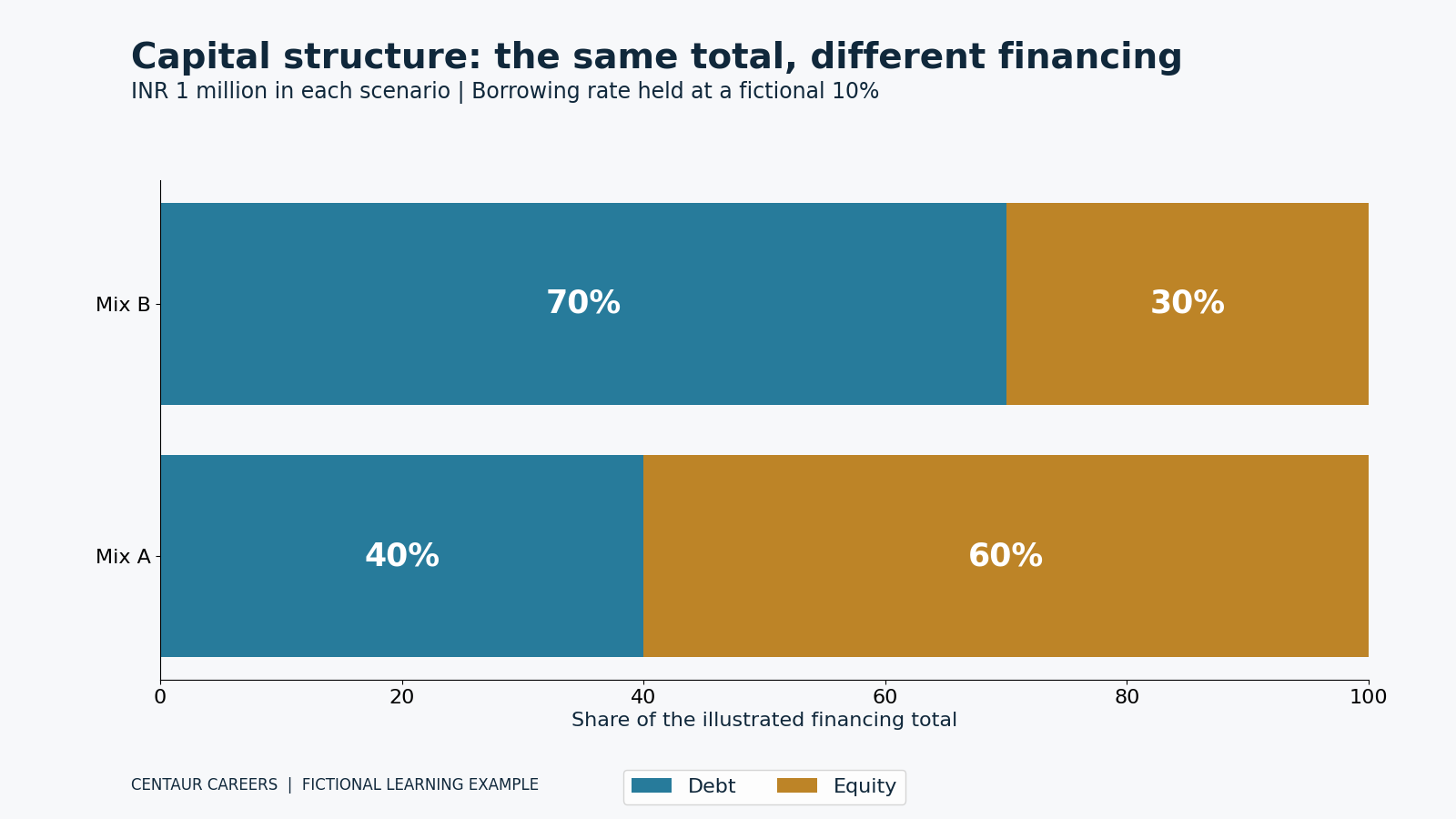
Mix A contains INR 400,000 debt and INR 600,000 equity. Mix B contains INR 700,000 debt and INR 300,000 equity. These are simplified financing inputs, not market-value estimates. Assume annual interest is 10% in both mixes solely to isolate arithmetic. Tax, fees, principal repayments and preference shares are excluded. Assume annual operating profit before interest and tax is INR 150,000.
| Measure | Mix A | Mix B |
|---|---|---|
| Debt / equity | 0.67 times, rounded | 2.33 times, rounded |
| Annual interest at 10% | INR 40,000 | INR 70,000 |
| Operating profit before interest and tax | INR 150,000 | INR 150,000 |
| Profit before tax after this interest only | INR 110,000 | INR 80,000 |
| Interest cover | 3.75 times | 2.14 times, rounded |
Stress the operating result
If operating profit falls to INR 60,000, interest cover becomes 60,000 / 40,000 = 1.50 times for Mix A and 60,000 / 70,000 = about 0.86 times for Mix B. Mix B then records a loss before tax of INR 10,000 after the assumed interest. The larger contractual interest burden makes the result more sensitive to an operating decline.
Coverage is an accounting indicator, not proof of cash available to pay a lender. Customer invoices may remain uncollected, investment may be needed, and principal may fall due. Review a dated cash forecast and repayment schedule. This exercise does not establish a universal safe interest-cover threshold.
Why borrowing costs can change with leverage
Holding the interest rate at 10% makes the comparison simple. A real lender may require a higher rate, different security or tighter covenants when borrowing increases. Equity investors may also require a higher return when contractual claims ahead of them rise. Replacing equity with debt therefore cannot be assumed to improve funding cost indefinitely while all risk inputs stay fixed.
Book values and market weights
Balance-sheet equity is an accounting amount. Market equity for a listed business relates to the relevant share count and market price at a specified date. They can differ substantially. A WACC analysis ordinarily needs a justified market-value or target weighting basis rather than automatically using the simple funding amounts above. Identify what is included in debt and whether a proxy replaces an unavailable market value.
Questions for a financing review
- Which interest and principal payments fall due, on which dates and in which currencies?
- How does cash behave under delayed receipts or lower sales?
- What security, covenants, conversion rights and refinancing needs apply?
- How would new equity affect control and ownership?
- Are weights based on observable market values, a target mix or a documented proxy?
Practice: increase the rate as well as the borrowing
Raise only Mix B's assumed rate to 12%. Annual interest becomes INR 84,000. At INR 150,000 operating profit, interest cover is about 1.79 times; at INR 60,000 operating profit, loss before tax becomes INR 24,000. Keep this scenario next to the original so the effect of more borrowing can be distinguished from the effect of a higher rate.
CFA Institute discusses capital structure, the simplifying assumptions behind theoretical results and the relevance of taxes and financial distress. This original two-mix case shows payment exposure; it does not identify an optimal financing structure for a real business.
Connect financing to broader financial-management decisions
Review a general ratio-analysis example
Calculate an illustrative WACC
Review the equity research subject in the Masterclass
CFA Institute: capital structure
Does a lower interest rate prove debt is best?
No. Review repayment dates, covenants, refinancing risk, tax, ownership and the cash forecast alongside the quoted rate.